
Digital marketing is the practice of using internet-connected channels to present, distribute, and measure informational content aimed at defined audiences. It encompasses methods for increasing visibility, attracting relevant visitors, and supporting user actions that align with organizational goals. Channels include searchable pages, social platforms, owned media such as email lists and websites, and paid placements. Activities are often planned around audience needs, content formats, and technical constraints, with an emphasis on measurement so that planners can compare outcomes across channels and adjust resource allocation over time.
Strategies in this field typically integrate multiple channels to create coherent experiences across discovery, engagement, and retention stages. Content formats may include short-form posts, long-form articles, video, and interactive tools; each format can serve different parts of a customer or user journey. Planning commonly involves setting measurable objectives, mapping content to audience segments, and coordinating timing across channels. Execution commonly requires monitoring metrics that reflect awareness, engagement, and subsequent actions, and interpreting those metrics to refine future content and channel selection.
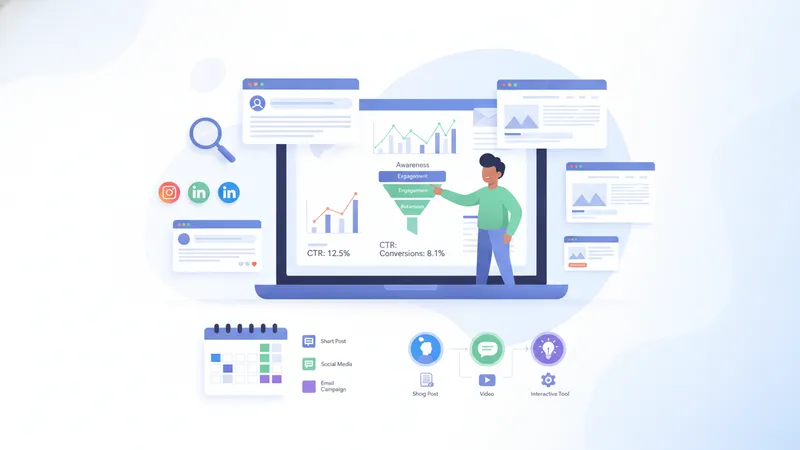
Channel selection often depends on the audience profile and the nature of the content. For example, searchable content may be preferable for informational queries, while short-form social posts can maintain ongoing engagement with existing followers. Channels may overlap: an article intended for search visibility can be repurposed into a social post series and a newsletter excerpt. Teams often map content types to distribution paths and estimate time-to-value for each channel, recognizing that organic approaches may take longer to show cumulative effects compared with some paid placements.
Measurement frameworks typically use a small set of indicators tied to objectives, such as visibility, engagement, and conversion-related signals. Visibility might be assessed by impressions or search rankings, engagement by time on page or social interactions, and conversion-related signals by form completions or contact requests. Analysts often combine quantitative data with qualitative feedback to understand why certain content performed as it did. Attribution can be complex; multi-touch models may be used to give partial credit to multiple channels that contributed to an outcome.
Content planning practices commonly include editorial calendars, content briefs, and performance retrospectives. Calendars help coordinate timing across channels and ensure that topics receive sufficient promotion and follow-up. Briefs may list target keywords or themes, suggested formats, and intended audience segments. After distribution, retrospectives typically compare predicted and actual performance to identify content themes or formats that frequently resonate. These routines may help reduce duplication of effort and support incremental improvement in content relevance and technical quality.
Audience segmentation and personalization are often applied to increase relevance. Segments may be defined by behavioral signals, demographic attributes, or expressed preferences. Personalization can range from simple segment-based email variants to content selection that adapts to prior interactions. Privacy and data governance considerations commonly constrain the granularity of personalization; practitioners typically balance relevance gains with compliance and user expectations. Measurement of segment-level performance may reveal which combinations of messaging and channel tend to produce stronger responses.
In summary, digital marketing integrates content, channels, and measurement to support defined communication objectives. It relies on coordinated content planning, thoughtful channel selection, and iterative measurement to refine approaches over time. Practitioners often treat outcomes as probabilistic and use modest experiments to learn what tends to work for target audiences. The next sections examine practical components and considerations in more detail.
Different channels typically serve distinct roles within an integrated digital approach. Search-focused channels often function as discovery points when users express intent through queries, while social channels may support ongoing engagement and community interaction. Email frequently acts as a retention and reactivation channel for known contacts. Paid placements can extend reach quickly but may require ongoing investment to maintain exposure. When planners design a strategy they often classify channels by role—discovery, engagement, conversion, or retention—to clarify how each contributes to overall objectives and where measurement efforts should be concentrated.
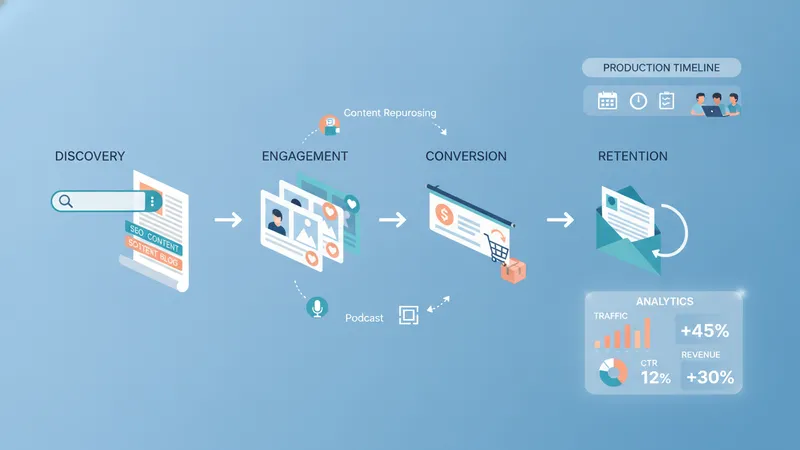
Channel characteristics influence content format and production processes. For example, search and longer-form content may require deeper topic research and keyword alignment, whereas social content often prioritizes concise messaging and visual assets. Production cadence may differ: social may demand frequent content drops, while long-form pieces can be distributed less frequently but repurposed across channels. Teams often establish lightweight production workflows that match channel tempo to available resources, helping ensure that content quality remains consistent without overextending staff or contributors.
Integration across channels is a common practical consideration. Cross-promotion can amplify reach—for instance, a research article may be summarized in social posts and linked in an email newsletter. Attribution systems often struggle to capture the full value of these interactions, so planners may use controlled experiments and comparative timing to estimate complementary effects. Consistent branding and messaging across channels can reduce audience confusion, while channel-specific adaptations maintain relevance to audience expectations and technical constraints, such as character limits or recommended media resolutions.
Channel governance and operational practices also matter. Owners often assign channel responsibilities, set publishing standards, and maintain content libraries that include approved templates and legal disclaimers when needed. Access controls and scheduling tools may reduce operational risk and help ensure that messages are reviewed before publication. Analytics collection should be consistent across channels to facilitate cross-channel comparisons; this often involves standardizing UTM tagging, page-level metrics, and event definitions so that performance signals can be aggregated and compared reliably.
Search-focused activities often combine technical site work, content creation, and external referencing. Technical work may include improving site structure, page speed, and indexability so that search engines can access and interpret content easily. Content creation for search typically targets questions or topics that users search for, using supported formats like articles, guides, and structured data when relevant. External referencing—links from other sites—can influence perceived authority, though the effect can vary by sector and context. Practitioners usually frame SEO as a long-term effort that may show cumulative benefits over time.

Content strategy for search often begins with topic research and audience mapping. Topic research may identify recurring queries and content gaps where helpful content could meet user needs. Audience mapping helps prioritize which questions to answer based on audience segments and their stage in the decision or information journey. Content briefs may include target themes, suggested headings, and internal linking plans. After publication, performance is evaluated on metrics such as organic traffic, query visibility, and engagement signals; insights then inform subsequent editorial priorities.
Technical considerations can materially affect search outcomes. Site architecture that supports clear hierarchical navigation and logical URL patterns may help search engines and users find relevant pages. Page load time and mobile responsiveness often correlate with engagement metrics; addressing these aspects may improve user experience and organic performance. Structured markup (schema) can help search engines present content in enhanced formats. Teams commonly balance content improvements with technical fixes to address both discoverability and usability in parallel.
Content maintenance is an often-overlooked component of long-term SEO performance. Regular reviews may identify outdated information, broken links, or opportunities to consolidate overlapping pages. Refreshing or expanding existing content can be more efficient than creating new pages for similar topics. Measurement of historical performance trends can help prioritize maintenance actions that are likely to yield improved visibility or engagement. This maintenance approach treats content as an evolving asset rather than a one-time deliverable.
Segmenting audiences typically helps match messages to differing needs and contexts. Segments may be based on observable behavior (such as pages visited or prior purchases), self-declared attributes (such as interests or role), or inferred propensity signals. Once segments are defined, messaging variants can be prepared to emphasize relevant benefits, answer likely questions, or address common barriers. Segmentation commonly improves relevance but adds complexity in production and measurement; practitioners often start with a few high-value segments and iterate based on observed lift in engagement metrics.

Privacy and consent norms shape segmentation approaches. Data protection practices and platform policies often constrain how granularly personal information can be used for targeting. As a result, many teams combine first-party behavioral signals, aggregated insights, and contextual signals to form practical segments that respect privacy expectations. Transparent data practices and clear user-facing choices commonly help maintain trust when personalization is applied, and designers often build fallback experiences for users who opt out of certain tracking methods.
Message testing is frequently used to discover which content elements resonate with particular segments. A/B tests, subject-line variants, and landing page experiments may reveal differences in open rates, time on page, or completion rates across segments. Tests are typically framed conservatively: they may indicate tendencies rather than definitive causal proofs, especially when sample sizes are limited. Results often inform incremental changes rather than wholesale strategy shifts, and teams frequently replicate tests across channels to validate patterns.
Operationally, segment-aware workflows often require content modularity and tagging systems so that variants can be produced without duplicating effort. Content components—such as headlines, lead paragraphs, and call-to-information elements—may be assembled dynamically based on segment rules. Analytics setups should capture segment-level performance so that planners can compare relative effectiveness and decide where to allocate production time. These considerations help balance personalization benefits against practical resource constraints.
Measurement frameworks generally start by aligning metrics to the stages of a communication objective, such as awareness, engagement, and action. Metrics commonly used include impressions or reach for awareness, engagement indicators like time on page or interaction rates, and conversion-related signals such as form completions or downloads. Practitioners often avoid single-metric judgments and instead consider metric combinations that reflect movement along the user journey. Consistent definitions and tracking practices are important for valid comparisons across time and channels.

Attribution and data integration are frequent challenges. Single-touch attribution methods may overstate or understate the contribution of particular channels, while multi-touch approaches require more data and assumptions. Analysts often use a mix of attribution models, experiments, and contextual analysis to form balanced interpretations. Data integration—combining analytics, CRM, and advertising platforms—can improve insight quality but also requires careful alignment of identifiers and event definitions to avoid misleading conclusions.
Reporting design matters for interpretation and actionability. Clear dashboards typically present a small set of prioritized metrics with contextual notes about time frames, segmentation, and recent changes. Annotation of reports to indicate content publications, platform updates, or external events can help explain sudden shifts. Regular performance reviews, such as monthly or quarterly sessions, often pair metric summaries with qualitative observations about audience feedback or content reception to form a richer understanding of what may be driving results.
Interpreting performance often benefits from modest experimentation. Small controlled tests—altering a headline, changing a distribution schedule, or varying an email subject line—may reveal patterns that scale. Experiments are commonly treated as learning activities rather than final proofs, and their outcomes typically guide incremental adjustments. Over time, a portfolio of documented experiments can build practical knowledge about which content formats, channels, and messages tend to align with organizational aims and audience preferences.